
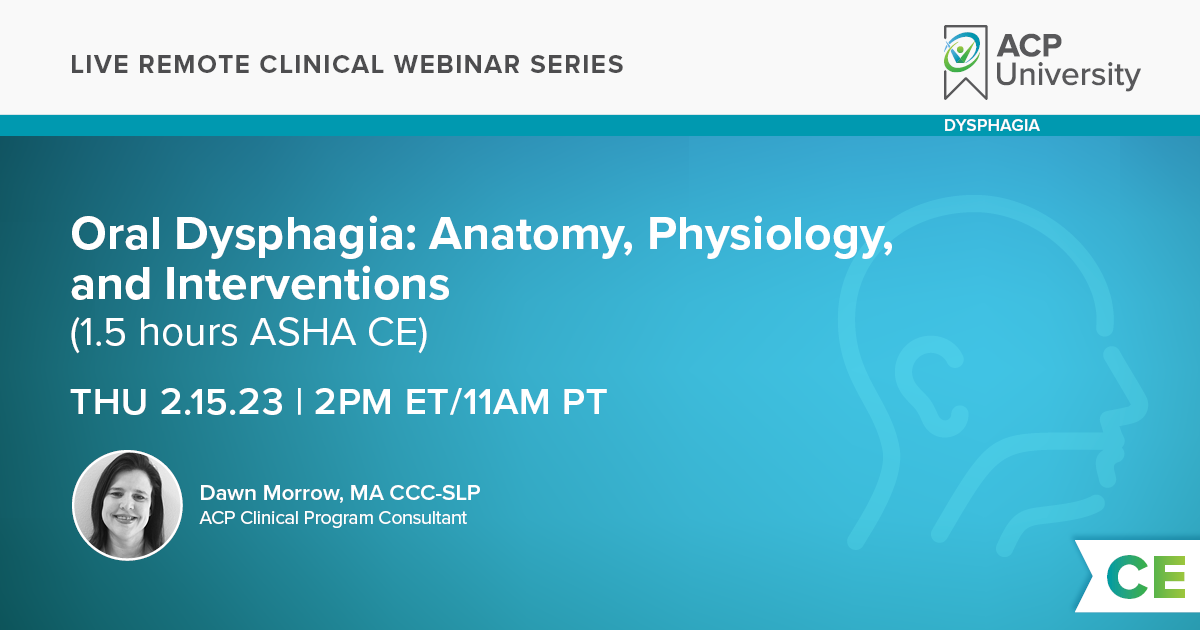
Oral Dysphagia: Anatomy, Physiology, and Interventions
Date and Time
Location
Virtual Event
About this course:
A comprehensive understanding of swallowing kinematics includes adequate consideration of the oral phase. Through a combination of didactic lecture and lab demonstration the anatomy and physiology of the oral phase of swallowing will be reviewed. Furthermore, this course discusses evidence-based assessment, research, and therapeutic interventions, including that of surface electromyography (sEMG) relating to the oral phase of swallowing.
This course is offered for ASHA CEUs (Intermediate level, Professional area).
Instructor:
Enroll Now
Please note: You will not be able to register for webinars without an active
ACP University (LMS) account.
Existing Account
Auto-Enrollment
For the best experience, download the Adobe Learning Manager App
and use the below QR code to automatically enroll anytime leading up to the start of the course.
Existing Account Enrollment Request
If you already have an account but can’t scan the QR code,
complete our form and we will add you to the course.
Requests must be received 24 hours prior to the course’s scheduled start.
ACP University Account Request
An active ACP University (LMS) account is required to register for this course. If you don’t have an
account, please reach out to your Clinical Program Consultant for your facility-specific learner link.
If you don’t recall who your CPC is, reach out to us at [email protected].
Related Events
October 22, 2026
sEMG Biofeedback in Dysphagia Rehabilitation
This one and one-half half hour intermediate level course reviews the use of surface electromyography (sEMG) in dysphagia research and clinical practice. It discusses sEMG dysphagia assessment and exercises including typical swallow, effortful swallow, and Mendelsohn maneuver. This course also includes lab demonstrations of sEMG and its role as part of a successful dysphagia rehab program.
October 27, 2026
Frailty Series - Frailty Overview
Frailty is a geriatric syndrome which leads to increased vulnerability to stressors, affects overall health and quality of life, and limits functional mobility and ADL/IADL. Clinical Practice Guidelines recommend interdisciplinary team management to prevent or reverse frailty. Incorporating frailty interventions and leveraging existing evidence-based strategies will facilitate optimal outcomes for residents with frailty. This course provides a review of frailty definitions, risk factors, pathophysiology, screening and assessment tools, and emphasizes the relationship between frailty and other geriatric syndromes and chronic diseases.