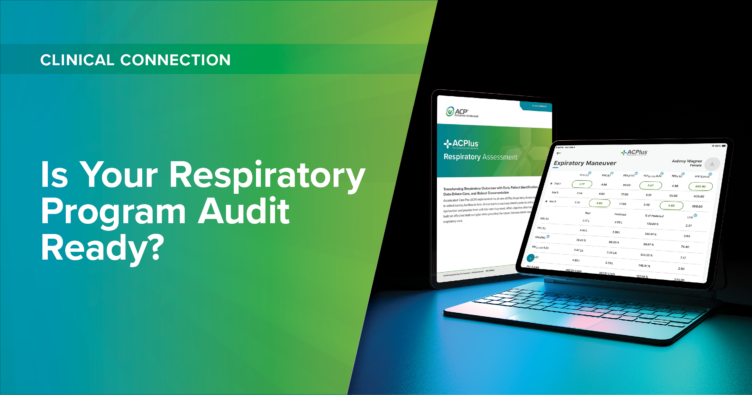
Is Your Respiratory Program Audit Ready?
Start With These 6 Questions
Respiratory therapy reimbursement in skilled nursing is under increasing scrutiny, and the stakes are high. A recent McKnight’s article highlighted six questions that can help providers assess whether their respiratory program is truly defensible, from clinical appropriateness to staff qualification and documentation.
The questions are straightforward. Consistently providing justifiable answers requires disciplined clinical processes, qualified staff, and reliable documentation.
ACPlus Respiratory Assessment (ARA) by ACP is an innovative software that helps skilled nursing operators proactively identify patients with pulmonary dysfunction and provide them with the care they need. ARA’s objective data supports clinicians in building effective treatment plans while generating the robust documentation needed to justify respiratory care and support reimbursement.
National HealthCare Corporation (NHC), one of the nation’s leading post-acute care providers, began piloting ARA in June 2023. Their experience offers a real-world look at what it means to build a respiratory program that can confidently answer these questions.
1. Was care clinically appropriate?
This requires a documented respiratory need, a physician order specifying frequency, duration, and scope of treatment, and a resident-specific care plan. ARA’s objective assessment data helps clinicians identify pulmonary dysfunction early, even when patients show no obvious symptoms. Sarah Ison, Regional Therapy Director for NHC’s central region, noted that approximately 95% of patients assessed returned results indicating a respiratory deficit. “It has really helped us to identify patients who would benefit from respiratory therapy, whom we might not have typically provided that service to,” she said.
2. Did the activity meet the respiratory therapy definition?
Every staff member needs to be working from the same definitions of what counts as respiratory therapy. ARA promotes consistency of assessments and interpretation of results across all care providers. NHC found that building a systematic assessment workflow was key: testing every new admission within the first three days and conducting quarterly assessments for long-term care residents.
3. Was the provider qualified?
The Resident Assessment Instrument (RAI) manual is specific. Care must be delivered by a respiratory therapist or respiratory nurse with documented training in each modality provided. ARA’s flexibility supports a range of qualified staff. NHC’s pilot facilities have used therapists, nurses, nurse practitioners, and respiratory therapists to conduct assessments, with documentation practices designed to withstand audit scrutiny months or years later.
4. Can you prove competency?
Training materials need to be producible on demand. Ison’s advice for facilities getting started: secure buy-in from leadership and key staff members early and develop a systematic approach for conducting assessments. A well-implemented plan using ARA gives facilities a structured framework for standardizing respiratory protocols and ensuring staff are working from the same foundation.
5. Can you prove consistency?
Use the same standards, same definitions, same documentation across every shift and every staff member. As the McKnight’s piece noted, if every nurse answers the definition question a little differently, you’re not defending one respiratory program; you’re dealing with multiple variations within the same facility. NHC addressed this by remaining flexible and willing to adjust processes until they found a sustainable workflow that succeeded across their pilot buildings.
6. Can you prove the full story?
This means connecting resident need to physician order, physician order to treatment delivered, treatment to documentation, and documentation to qualified staff. For NHC, ARA’s robust documentation has been central to that chain. “Our documentation is constantly being reviewed,” Ison said, “so we have found it was extremely beneficial having those ARA results and the documentation of those deficits to support what we were capturing on the MDS.”
The Results Speak for Themselves
At one of NHC’s inpatient facilities, ARA’s impact has been sizeable. In one year, rehospitalization rates dropped 36%, average daily Medicare Part A reimbursement increased 4%, and Medicaid reimbursement rose 7.4%. As Ison noted, these numbers reflect not just financial value but improved patient care and better outcomes.
Facilities that can answer these six questions are better positioned to protect their residents, their reimbursement, and their program’s long-term viability.
Transform Respiratory Outcomes with ARA
Find out how ARA can support your respiratory program.
NHC’s experience does not represent a claim made by Accelerated Care Plus. Results with ACPlus® Respiratory Assessment may vary.
MRK-BLOG-047
Could your respiratory program survive an audit? A recent McKnight’s article outlines six questions every skilled nursing provider should be able to answer. See how one operator built a defensible program and cut rehospitalizations by 36% along the way.
Latest Updates
Subscribe to stay up-to-date on our latest posts.