Tag: virtual reality exercise

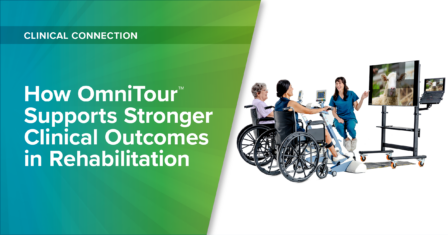
How OmniTour™ Supports Stronger Clinical Outcomes in Rehabilitation

How OmniTour™ Supports Stronger Clinical Outcomes in Rehabilitation

Before investing in a new therapy tool, the question that matters most to facilities is simple: Does it actually work?

For rehab teams, “working” means more than patients enjoying a session. It means measurable progress; patients who train harder, recover faster, and achieve their functional goals.

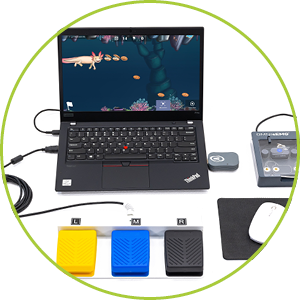
To better understand the impact of the OmniTour™ Virtual Exercise Experience on facility outcomes, we asked clinicians to share their experience, and the results were promising.
What Clinicians Reported

In a December 2025 survey of 25 OmniTour users, 92% of clinicians rated OmniTour as extremely or very effective at impacting outcomes in their facilities. When asked to identify which OmniTour benefits were most responsible for those outcome improvements, clinicians pointed to two factors above all others: patients training with greater effort and patients training more often.

Training effort and frequency are foundational to recovery, and OmniTour meaningfully supports both.

Effort + Frequency = Better Patient Outcomes

In rehabilitation, outcomes are largely dose-dependent. We know that patients who participate more frequently and push themselves harder during therapy sessions make greater functional gains. The challenge has always been sustaining that level of participation over time, especially in longer-term or post-acute settings where motivation often wanes.

When therapy becomes something patients look forward to, rather than something they endure, it changes the game. Patients don’t just show up; they engage. Over time, that engagement compounds into better clinical results.

Moving Beyond the Numbers

The survey data is compelling, but the qualitative feedback we received from clinicians paints a vivid picture of sustained engagement:

My long-term patients love it. They have started coming to the gym more often. It’s very helpful for long-term programming.

Another clinician shared that OmniTour has made a “significant impact” on overall patient satisfaction, a factor closely tied to adherence and overall recovery success.

The OmniTour Advantage

OmniTour isn’t designed to replace skilled clinical intervention, but it does enhance it. By giving patients a reason to train harder and return more consistently, it amplifies the work therapists are already doing. For rehab teams looking to get more out of every session, that kind of amplification has real clinical and operational value.

MRK-BLOG-041

Before investing in a new therapy tool, the question that matters most to facilities is simple: Does it actually work? For rehab teams, “working” means more than patients enjoying a session. It means measurable progress; patients who train harder, recover faster, and achieve their functional goals. To better understand the impact of the OmniTour™ Virtual Exercise Experience on facility outcomes, we asked clinicians to share their experience, and the results were promising.
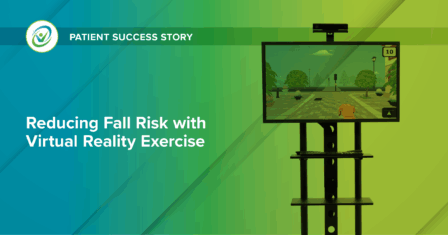
Reducing Fall Risk with Virtual Reality Exercise

Reducing Fall Risk with Virtual Reality Exercise 

This 71-year-old woman experienced nine falls in one week and a urinary tract infection (UTI) that resulted in a five-day hospitalization. Following her hospital stay, she required increased assistance with all functional tasks. Before this hospitalization, she lived with her grandchildren and was able to independently walk, navigate stairs, and complete all functional activities, including meal preparation.  

To restore her functional abilities, she was referred to a skilled nursing facility for rehabilitation services. 

Therapy Protocol

Physical & Occupational Therapy

  • 5x/week x 2 weeks

OmniVR® Virtual Rehabilitation System 

  • Transfer training using Bingo virtual reality (VR) exercise 
  • Balance and gait using City Walk VR exercise 

Additional Interventions 

  • Gait training, balance training, and therapeutic exercise 

OmniVR® Virtual Rehabilitation System 

OmniVR®

Virtual Reality Rehabilitation System

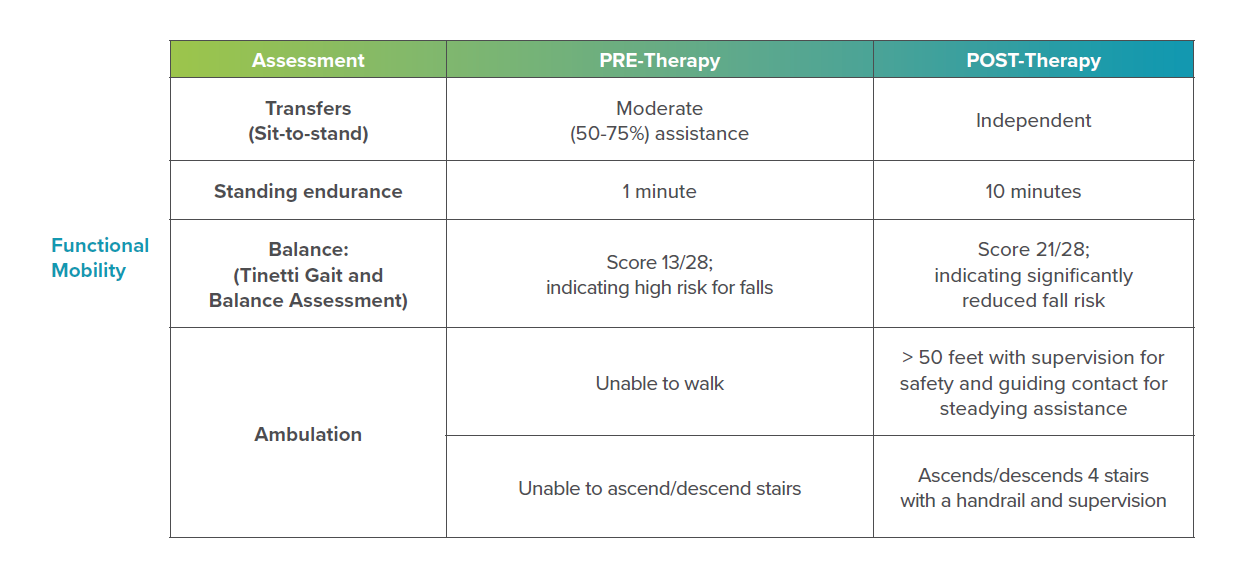
After only two weeks of physical and occupational therapy, this patient was able to sit-to-stand independently, stand longer, walk and use stairs, and significantly reduce her fall risk. 

Reducing Fall Risk with Virtual Reality Exercise 

This patient was very happy she progressed so quickly with therapy and that she was able to return home with her family’s support. Her therapists feel the OmniVR really helped improve her ability to get up from the chair and walk. 

I really like competing with the other patients on Bingo!

Patient

MRK-BLOG-029

This 71-year-old patient experienced nine falls within a week and a urinary tract infection that resulted in a five-day hospitalization. Following her hospital stay, she required increased assistance with all functional tasks. Before this hospitalization, she lived with her grandchildren and could independently walk, navigate stairs, and complete all functional activities, including meal preparation. To restore her functional abilities, she was referred to a skilled nursing facility for rehabilitation services. Learn how her care team used virtual reality exercise to regain her mobility.

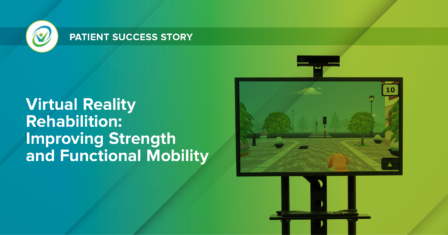
Virtual Reality Rehabilition: Improving Strength and Functional Mobility

Virtual Reality Rehabilition: Improving Strength and Functional Mobility 

While battling kidney cancer, this 72-year-old patient began experiencing weakness, foot drop, coordination deficits, and an unsteady gait. Before being referred to a skilled nursing facility for rehabilitation service, he lived at home with his wife, ambulated with a walker, and required some assistance with self-care.

Therapy Protocol

Physical & Occupational Therapy

  • 3-5x/week x 8 weeks

OmniVR® Virtual Rehabilitation System

  • Virtual reality exercise performed using Carnival, Bingo, and Picnic activities with progression in intensity and resistance to increase arm and leg strength

Additional Interventions

  • Training in transfers and gait; self-care management 

OmniVR®

Virtual Rehabilitation System

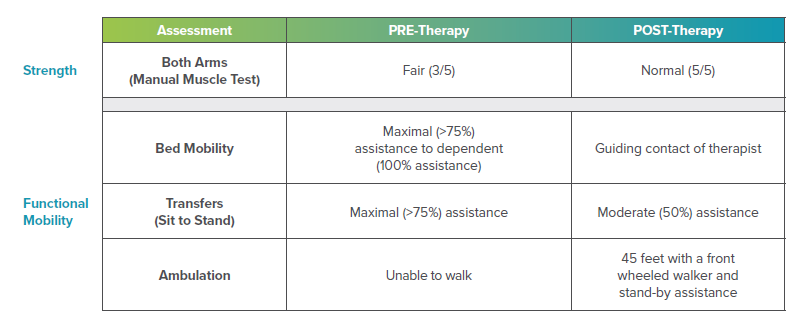
Following the 8-week rehabilitation program, enhanced with virtual reality, the patient demonstrated notable progress: 

Virtual Reality Rehabilition: Improving Strength and Functional Mobility

The patient’s therapist shared that he made significant progress in strength and functional mobility using OmniVR®’s virtual exercise activities, allowing him to achieve his goal of returning home with his wife!  

MRK-BLOG-022

While battling kidney cancer, this 72-year-old patient began experiencing weakness, foot drop, coordination deficits, and an unsteady gate. Before being referred to a skilled nursing facility for rehabilitation service, he lived at home with his wife, ambulated with a walker, and required some assistance with self-care. Find out how his therapy team used virtual reality rehabilitation to help get him home.